Book Review: Oromay by Baalu Girma
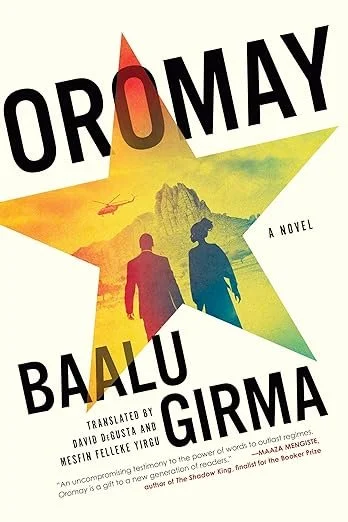
A brother destroyed by his love for speed; a man disappeared because his wife’s beauty drew in a government official; a church – and the stockade of automatic weapons hidden within – disintegrating under a volley of gunfire; a woman walking the city streets, shouting “dogs are better than humans!” These events are not central to the narrative of Baalu Girma’s Oromay, but they are all entangled within “life’s permanently expanding web” in this 1982 Ethiopian novel.
In Oromay, Tsegaye Hailemaryam, a television journalist, is recruited to lead the propaganda department of the Red Star Campaign – a military action during which the revolutionary Ethiopian government planned to stamp out Eritrean nationalist insurgents in a videogenic, narrative-shaping, and permanent manner.
The first few chapters of the novel frame the campaign as both an invading threat to and a romantic lover of the city of Asmara. This paradox shapes the novel, which alternately takes on features of a mid-century spy novel, a war novel, a romance (in the early modern as well as the contemporary sense), and a tragedy. We follow Tsegaye, who is driven by the force of his belief in revolutionary post-imperial Ethiopia, as he hobnobs with important figures in the Derg government. His duty is to convince the common people of the righteous monumentality of the campaign, to document these meetings and battles “for people today to know, and for future generations to understand.”
Oromay’s satirical ‘view-from-the-inside’ perspective sets it apart from many contemporaneous post-imperial/post-colonial African novels. There is little of the bottom-up, everyman/woman historical approach which abounds in modern fiction. Instead, most of the central figures, especially in the first two-thirds of the novel, are quintessential ‘great men’ – from leaders of the Derg government, to high ranking military officials, intelligence division chiefs, and commanders of the insurgency. Baalu Girma depicts real characters such as Derg Chairman Mengistu and Eritrean People’s Liberation Front (EPLF) leader Isaias Afewerki, as well as obvious fictional representations of other prominent public figures. To earn space in Oromay’s early sections, characters must play active roles in shaping the present and future of Ethiopia. As a result, the lived experience of the ‘common man’ is set aside for a chorus of perspectives of these high-ranking individuals on the proletariat and how their opinions, ideology, and memories can be altered. The narrator presents insider knowledge of the personal failings of near-mythical figures who he depicts as mere humans: men who avoid smiling in fear of revealing their false teeth, compulsively clean their offices in hypochondria-fueled panics, and can be “such a sweet bag of nuts.” It is not difficult to understand the appeal of Oromay – this literary portal into the war rooms of Derg-ruled Ethiopia – to the contemporary reader.
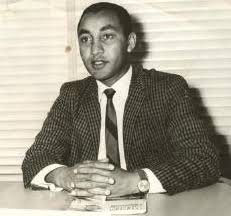
Baalu Girma (from ezega.com)
The perspective that makes Oromay unique also renders incomplete any consideration of the novel in isolation from its author’s life and presumed death. Baalu Girma, like his main character Tsegaye, was a journalist embedded within the Derg government. He worked closely with Chairman Mengistu in his position as a top official in the Ministry of Information and leader of propaganda for the Red Star Campaign. However, care must be taken to avoid conflating his thoughts and actions with those of Tsegaye. Girma may have foreseen the ease with which his creation could be transformed into his shadow-self; he includes a separate narrative voice, identified as the author, which seems to exist partially to remind readers of the difference between Tsegaye, “a mere mortal”, and Baal Girma himself.
When Oromay was published one year after the Red Star Campaign began, the novel was banned, existing copies were destroyed, and Baalu Girma was fired from his job. On February 14, 1984, he would leave his Addis-Ababa home to meet with friends and disappear forever. Is the danger in Oromay simply that of a mirror which reflects all that it sees, or was there some greater threat contained within?
The counter-revolutionary ideas of Oromay sprinkle the first two-thirds of the book, then form a deluge that sweeps the reader into a new perspective in the novel’s final third. Initially, Tsegaye is a wholehearted, almost credulous, believer in the Red Star Campaign and the revolutionary Ethiopian government. He describes the chairman in worshipful terms – “to see him is to believe in him” – and negative opinions about political actors and government leaders come from older, more jaded characters such as the Asmara administrator and the campaign’s chief of intelligence. Then Tsegaye goes to the warfront to document the battles. There, he interacts with common soldiers and watches them die. He witnesses their blood-soaked victory and sees it squandered by the poor logistic planning of his elite pals. Tsegaye becomes disillusioned with the ruling class and the flippancy with which they generate war plans; his happiness is ruined because “other men have been sacrificed for you to feel victorious.” In this section of the novel, the narrative dwells on the sacrifices of ordinary Ethiopians at war and at home. Still, it is important to note that Tsegaye’s belief in the government’s revolutionary ideals does not waver. His perspective on the wrongness of Eritrean nationalism does not change, and neither does his dream of a ‘united Ethiopia’. The questions raised are centered on the problem of leadership.
Oromay is a book obsessed with history-making. As the director of propaganda, Tsegaye must think about what is left for future generations, but many other characters are equally preoccupied with how they will be remembered. Small-fry officials want Tsegaye’s TV crews at their events. Several generals try to convince him to document their battles. Tsegaye himself worries that “history will happen. I won’t be able to record it, and the future will laugh at me.” The inflection point of Oromay comes with a shift in these concerns about historical documentation. When Colonel Wolday shoots a wounded insurgent in the head, he turns to Tsegaye and asks “How’s that for history?” After the battle in Nakfa, Tsegaye decides that he has “no interest in recording the mayhem of war, the absurd suffering humans inflict upon each other. It is offensive and beneath the dignity of humanity, worthless to future generations.” Yet, the reader cannot help but infer that this novel was written for that purpose – for history, for people then to know, and for future generations to understand.
The title of the novel is defined by one of its characters as “Done, finished, the end, it’s over.” In perhaps its most unintentionally prescient passage, a government official talks about the potentiality of each new Ethiopian generation waking up and rebelling against the previous one ad infinitum. Since the publication of Oromay, Ethiopia (and many other countries in Africa and beyond) has been caught in a constantly reinforced cycle of battles with its own history. Two allied Liberation fronts defeat the revolutionary government and shape the countries that emerge using Derg-rejected ethnicity-driven orders. Tension mounts between them and the new war causes the deaths of over a hundred thousand combatants. The results of the war and litigation on a global scale leaves everyone dissatisfied. Another grand Ethiopian renaissance led by another young messiah so distant from and so unbeholden to the previous regime. Another civil war, though now the states are aligned against an ethnic province led by the former ruling liberation force. The messiah, a sitting president, offers his people to do the soldiering rich countries would rather their sons didn’t – the marching, the killing, the dying. Oromay, but never really.
Books:
Oromay by Baalu Girma, translated by David DeGusta and Mesfin Felleke Yirgu. Many thanks to Soho Press and NetGalley for an Advanced Reader Copy.
The Ethiopian Revolution: War in the Horn of Africa by Gebru Tareke
